On October 1, 2026, Meta ends one of the quiet assumptions almost every WhatsApp-based support team has built their cost model on: that replying to a customer inside the 24-hour "customer service window" is free. It hasn't been entirely free since July 2025, when Meta moved to per-template billing — but the free-form replies your agents (human or AI) send back to a customer, and the utility templates you fire off mid-conversation, have stayed untouched. That changes in five weeks.
This isn't a rumor pulled from a roadmap leak. It's on Meta's own developer documentation, and WhatsApp Business Solution Providers — from Zendesk to a long list of BSPs — have been messaging their customers about it since Meta's August 10, 2026 announcement. If your support volume runs through WhatsApp, this is worth five minutes now rather than a surprise invoice in November.
What's Actually Changing on October 1, 2026
WhatsApp Business Platform pricing today has four message categories: marketing, utility, authentication, and service. Marketing, utility, and authentication templates are billed per delivered message — that's been true since the per-template shift on July 1, 2025. Service messages — the free-form back-and-forth a business sends once a customer opens a conversation — have been the one category that stayed free, along with any utility template sent within that already-open 24-hour window.
Starting October 1, 2026, both of those exceptions go away. Meta's documentation states plainly that "pricing updates for Meta Business Agent, service, and utility messages will launch on August 1, 2026 and October 1, 2026" — the first date covering Meta's own built-in AI agent, the second covering everyone else's service replies and in-window utility sends. Marketing and authentication pricing aren't changing; this is specifically about the messages support teams send once a conversation is already underway.
Meta hasn't published the final per-country rates yet — those are expected by September 1, 2026 — but multiple sources tracking the rollout (including Zendesk's own partner communications) report that service messages will be priced in line with existing utility and authentication rates for the same country, which today range from roughly $0.002 to $0.03 per message depending on market. Treat that as a directional estimate, not a locked-in number, until Meta's rate card lands.
The Timeline in One Place
| Date | What happens |
|---|---|
| July 1, 2025 | WhatsApp moves to per-template billing (marketing, utility, authentication) |
| August 1, 2026 | Meta Business Agent (Meta's built-in AI) switches to token-based billing — reported at roughly $2 per million tokens, or about $0.04–$0.05 per typical message |
| September 1, 2026 | Meta expected to publish final per-country rates for the new service/utility charges |
| October 1, 2026 | Service messages and in-window utility templates become billable for every business on the platform |
One narrow exception survives: conversations that start from a Click-to-WhatsApp ad or a Facebook Page CTA button keep a free delivery window — though if a Meta Business Agent is the one replying inside it, that reply still incurs token charges.
Why This Lands Harder in the Gulf Than Almost Anywhere Else
WhatsApp isn't just popular in the Gulf — it's close to the default communication layer. Infobip's 2026 usage data puts WhatsApp penetration at around 90% in both the UAE and Kuwait, and reports WhatsApp as the dominant chat platform across MENA, with usage on its platform growing 36% in the region in 2025 alone. Retailers, delivery apps, banks, and telecoms across Saudi Arabia and the UAE didn't add WhatsApp as one support channel among several — for a lot of them, it effectively is the support channel, with phone and web chat as secondary.
That concentration is exactly what makes this pricing shift structural rather than cosmetic. A business that runs 80–90% of its support volume through WhatsApp doesn't get to shrug off a per-message charge on service replies the way a business with a more even channel mix can. The cost moves from "the platform is free, we just pay our support software vendor" to "every reply has a marginal cost, on top of whatever we already pay for the agent or AI answering it."
The Real Risk Isn't the Price Tag — It's the Incentive It Creates
A flat per-message service charge quietly rewards a specific kind of behavior: resolving a conversation in as few messages as possible. That sounds fine in principle. In practice, it creates pressure in a few directions worth naming honestly:
Teams under cost pressure sometimes respond by cramming more into single messages, or by cutting the small clarifying questions that actually make a resolution accurate — which trades a real cost saving for a real quality regression. Support volumes that used to sprawl across a dozen back-and-forth messages now have a direct financial reason to be resolved in three or four, which is a legitimate design goal, but only if the AI or agent handling the conversation is actually good enough to do that without guessing. And any team whose entire support cost structure sits on one channel now has zero room to absorb a rate change Meta hasn't even finished publishing.
None of this means WhatsApp support stops making sense on October 2 — it's still where your customers already are, and switching channels isn't free either. It does mean the message-count assumptions in last year's budget need a second look.
How to Prepare Before October 1
A few concrete things are worth doing in the next few weeks, before the rate card lands on September 1:
Pull your actual average messages-per-resolution for WhatsApp conversations over the last 60–90 days. That number, multiplied by conversation volume and a rough per-message rate (use current utility/authentication rates for your top markets as a stand-in until Meta confirms), gives you a directional cost estimate rather than a guess. Look specifically at where message counts balloon — usually repeated clarifying questions, handoffs between bots and humans that restart the conversation, or status-check messages that could be handled with a single well-timed proactive update instead of three reactive ones.
Then look at channel concentration. If WhatsApp carries the overwhelming majority of your support volume, this is a reasonable moment to make voice, web chat, Instagram, or Messenger genuinely usable alternatives rather than channels that exist on paper — not to abandon WhatsApp, but so a pricing change on one platform doesn't move your entire cost base at once. Finally, shift the metric your team actually reports on from cost-per-message to cost-per-resolution. The first number is about to move for reasons outside your control; the second is the one that reflects whether your support is actually working.
Where an Omnichannel Setup Actually Helps
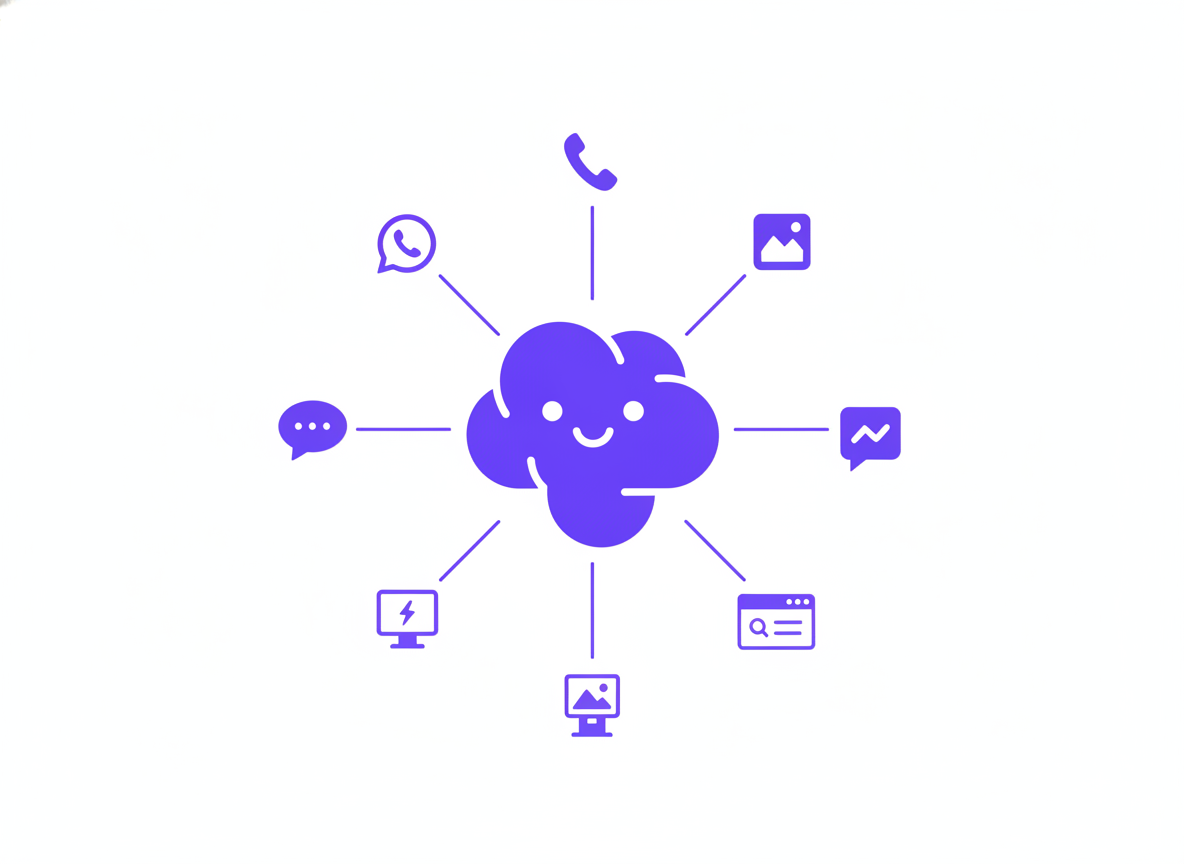
This is one of the more concrete arguments for running support as one AI agent across channels rather than a WhatsApp bot plus separate tools for voice, Instagram, and web chat. When a single agent — backed by a human co-pilot for escalations — handles voice calls, WhatsApp, Instagram, Messenger, kiosk, and web chat with the same context and the same resolution logic, a pricing change on any one channel is a cost-model adjustment, not a support-model crisis. It also means the conversations that are genuinely better suited to voice (a frustrated customer, a complex multi-step issue) can move there without losing context, instead of staying in WhatsApp by default because that's the only channel your stack supports well.
For Gulf businesses specifically, this matters doubly: the customers driving WhatsApp's 90% penetration are often the same ones who expect to be served in Gulf Arabic dialect, not just Modern Standard Arabic or English. An agent that's dialect-aware across every channel — not just the one you built first — is what lets a channel shift actually work instead of just moving the cost problem to a worse-handled channel. That's the practical version of "omnichannel": not a feature checkbox, but the thing that keeps a pricing change from becoming a support-quality regression.
The Bottom Line
October 1, 2026 doesn't break WhatsApp as a support channel, and it doesn't require an emergency migration. But it does end the specific assumption that free-form replies inside an open conversation cost nothing beyond your software bill — an assumption a lot of support budgets were quietly built on. The businesses that come out of this fine are the ones that already know their messages-per-resolution number, already track cost-per-resolution rather than cost-per-message, and already have at least one working alternative to WhatsApp for the conversations that don't need to be there. The five weeks between now and October 1 are enough time to become one of them, if you start this month rather than next.