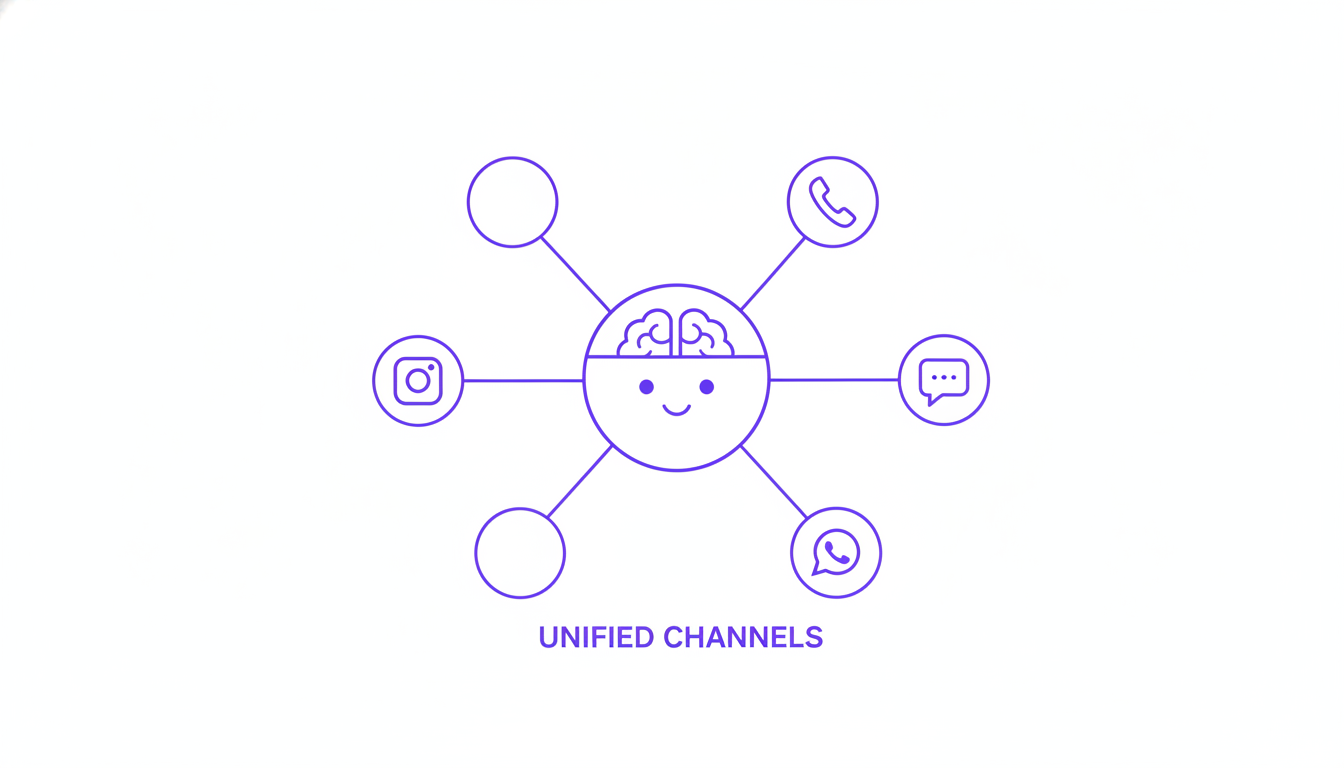
For years, "AI chatbot" meant a single widget bolted onto a website. That era is over. In 2026 the entire category has converged on a single idea: one AI agent, working off one knowledge base, across every channel a customer actually uses — voice, web chat, WhatsApp, Instagram, and beyond — with a human able to step in seamlessly when it matters.
The signals are impossible to miss. Chatbase, long the default "build a chatbot" tool, launched Chatbase Voice on May 8, 2026, explicitly pitched as "a single AI customer support system where chat, voice, email, and messaging all run through one agent configuration." A month later, Salesforce signed a definitive agreement (June 15, 2026) to acquire Fin (formerly Intercom) for roughly $3.6 billion, betting big on AI agents that resolve support end-to-end. When the market's two most-funded players both bet on the same "one agent, every channel" thesis in the same quarter, that's not a trend — it's the new baseline.
This guide breaks down the platforms actually competing for that omnichannel AI agent category in 2026, what each one is genuinely good at, and where the real gaps still sit.
What "omnichannel AI agent" actually means
A lot of vendors say "omnichannel" and mean "we also have a Slack integration." The bar that matters is higher. A true omnichannel AI agent should:
- Run from one shared knowledge base and one agent configuration, so answers stay consistent whether the customer calls, texts, or DMs.
- Cover voice as a first-class channel, not a bolted-on add-on years after the chat product matured.
- Reach customers where they already are — for most of the world outside North America, that increasingly means WhatsApp and Instagram, not just a website widget.
- Support a genuine human-AI hand-off: response suggestions, auto-summaries, and smart escalation rules, not just "transfer to agent" with no context carried over.
- Speak the languages and dialects a business's actual customers speak — not just translated English.
Judged against that bar, the field narrows quickly.
The 2026 shortlist
Chatbase
Chatbase serves 10,000+ businesses (including IHG, Miele, and Noon) and remains the category's biggest content and community machine. Its new Voice product (May 2026) runs on Twilio across 95+ languages and finally puts voice on the same knowledge base as chat. The catch: voice is brand-new here, pricing is credit-based (a recurring source of "Chatbase alternatives" searches), and native Instagram/social coverage still trails its chat product.
ElevenLabs (ElevenAgents)
ElevenLabs built its reputation on voice realism, and its conversational AI line — now branded ElevenAgents — is genuinely excellent at natural-sounding, low-latency voice across 70+ languages. But it's fundamentally voice infrastructure with agents layered on top, not a purpose-built customer-engagement platform. It under-indexes on WhatsApp/Instagram commerce use cases and human hand-off workflows that support teams actually need day to day.
Intercom Fin
Now operating as "Fin" ahead of the Salesforce acquisition, this is the enterprise incumbent: 30,000+ customers, an Apex-powered agent resolving roughly 76% of requests, and outcome-based pricing (around $0.99 per resolution). It's a serious platform for large support orgs — but per-resolution billing can produce bill shock at scale, Fin Voice remains limited-release, and channels like Telegram and LINE are still gaps.
Tidio (Lyro)
Tidio's Lyro is a strong, affordable pick for SMB e-commerce, especially Shopify and WooCommerce stores, with 120+ integrations and solid comparison content of its own. Its ceiling: no voice channel and no outbound campaigns, so it stays a chat-only tool as your channel needs grow.
Respond.io
Respond.io owns much of the "best WhatsApp chatbot" and omnichannel-inbox conversation, with a genuinely strong multi-channel messaging inbox. It's built more around routing and inbox management than a single configurable AI agent personality, and voice isn't part of the core product.
Teammates.ai
The one platform explicitly chasing both the global English market and the Arabic-speaking market at once, with claims of "20+ Arabic dialects" across 8+ channels starting around $25/month. Worth watching closely if dialect-accurate Arabic support matters to your business — it's the closest thing to direct competition on that front.
Qalyb
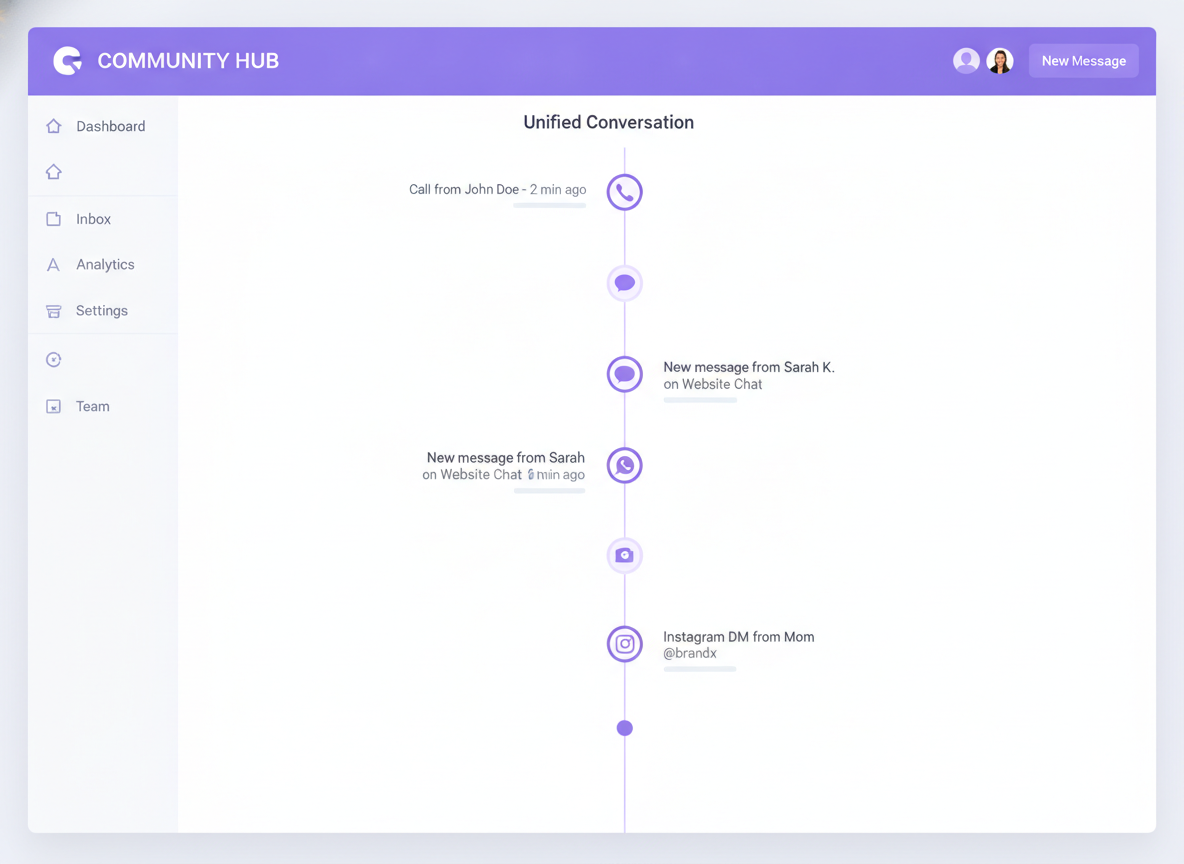
Qalyb's starting point is different: instead of adding voice to a chat product (or channels to a voice product), it's built natively as one agent across voice, WhatsApp, Instagram, Messenger, kiosks, and web chat from day one, on a single knowledge base, with a built-in human-agent co-pilot (knowledge search, response suggestions, form auto-fill, and call summaries) for the moments an AI agent should hand off rather than guess. It's also one of the few platforms built Arabic-first — including authentic Gulf and Omani dialect — rather than translated English, plus built-in outbound campaigns and an MCP server so the whole platform can be operated from tools like Claude.
Quick comparison
| Platform | Native voice | WhatsApp / Instagram | Human AI co-pilot | Arabic dialect depth | Best for |
|---|---|---|---|---|---|
| Chatbase | New (2026) | Chat-first | Limited | Translated only | High-volume chat support, large teams |
| ElevenLabs (ElevenAgents) | Strong | Limited | Limited | Translated only | Voice-realism-critical use cases |
| Intercom Fin | Limited release | Growing | Yes (enterprise) | Translated only | Large enterprise support orgs |
| Tidio (Lyro) | None | Chat only | Limited | Translated only | SMB e-commerce (Shopify/Woo) |
| Respond.io | None | Strong | Limited | Translated only | Messaging-inbox-centric teams |
| Teammates.ai | Growing | Growing | Limited | Strong (20+ dialects claimed) | Global + Arabic dual-market bets |
| Qalyb | Native, day one | Native (WhatsApp, Instagram, Messenger, kiosk) | Yes, built-in | Native, Gulf/Omani-authentic | Businesses that need one real omnichannel agent, worldwide or MENA-first |
How to choose
If your support volume is almost entirely web chat and you want the biggest content/community ecosystem, Chatbase is a reasonable default. If voice realism is the single most important variable — say, for a consumer voice product — ElevenLabs is hard to beat on audio quality alone. If you're a large enterprise that can absorb per-resolution pricing and needs deep CRM-grade workflows, Fin is built for that scale. If you're a small e-commerce shop that only needs chat, Tidio's Lyro is fast and cheap to set up.
But if the actual requirement is one agent that genuinely covers voice, WhatsApp, Instagram, and chat without stitching together three vendors — and especially if a meaningful share of your customers speak Arabic and expect to be understood in their own dialect, not a translated script — the shortlist narrows to Qalyb and Teammates.ai, and the co-pilot and native-channel depth is where Qalyb pulls ahead.
Where this is heading
The direction of the whole category is now obvious: every vendor is converging on "one agent, every channel." The differentiator in 2026 won't be whether a platform claims omnichannel — it'll be how deep that coverage actually goes, and whether the AI knows when to hand a conversation to a human instead of guessing. That's the bet Qalyb is built around.
Curious how Qalyb compares on your specific channel mix? Book a demo and see one agent handle a voice call, a WhatsApp thread, and an Instagram DM — all from the same knowledge base.